Show off your piercing placement | A guide to popular piercings, from painless piercings to the latest fashion trends
Welcome to the complete guide to piercing placement
Have you ever wondered, "I want to change the position of my piercings, but where should I get them pierced to create a look that suits me best?"
Positioning is also important when piercing your first earring.
What size earrings do you want to wear? Are your earlobes thick or thin? How much do you know about yourself?
This journal provides detailed information on popular piercing locations and how the impression changes depending on the piercing location, as well as the characteristics of each part of the ear, the pain and healing time when getting pierced for the first time, how well piercings go with fashion, and even how to pierce and provide aftercare.
This is the definitive guide to getting to know yourself and finding the piercing style that's perfect for you. We hope you enjoy reading it.
What you'll get from this journal
Learn the names and meanings of ear piercings by ear part
You can compare pain, healing time, and care methods
You can understand popular locations by age, gender, and lifestyle.
Learn styling techniques to match your fashion and hairstyle
Choose the best earrings from Aletta Jewelry in the position that suits you best.
Chapter 1 | The impression and meaning of piercing placement
The impression a person gives changes depending on the location of their piercing. The same piercing can give different impressions to those who see it, such as "cute" or "unique," depending on where it is worn.
1.1. The placement of the piercing is a matter of millimeter accuracy
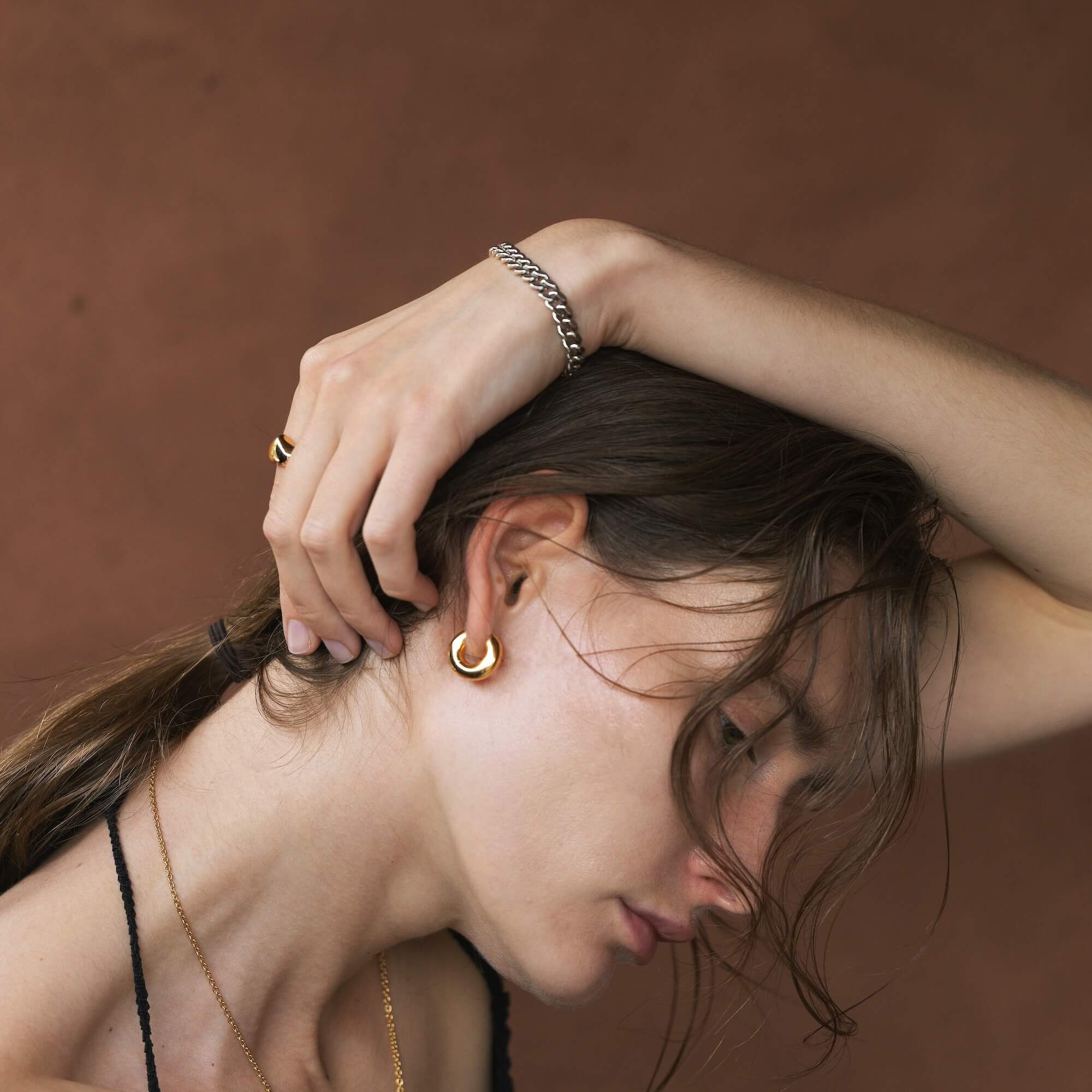
Wearing a small, cute stud earring right in the center of your earlobe will soften your overall look and make your smile look even more charming.
If you place the earrings just a few millimeters further out, it will accentuate your facial lines at an angle, giving you a sharp, cool impression. Just by slightly changing the position of the earrings, the impression of your face can change dramatically.

1-2. Right ear or left ear? Change your mood with the earrings you choose that day
If you're feeling more positive than usual today, try wearing a slightly larger hoop earring in your right ear. The right ear is said to represent intuition and creative sensibility, bringing out your free and artistic charm.
If you want to maintain a calm and composed atmosphere, try a simple and elegant pearl earring in your left ear. The left ear is said to hold the energy of stability and calm, adding a sense of trust and security to your words and actions.
-
Right ear : Creative, free, individual
-
Left ear : Elegance, calmness, and confidence
On work days, wear a modest small pearl earring in the lob of your left ear to create a calm look, and on your days off, enjoy a relaxed mood by wearing a hoop earring in the helix of your right ear.

Chapter 2 | Ear Parts and Piercing Location Guide
The delicately sparkling earrings on your ears are like a map of your individuality drawn out in "dots." We'll explain the story and meaning behind each piercing, along with tips on pain and care, depending on the location of the piercing.
| part | Location guide | pain* | Healing Period** | For beginners | Recommended jewelry examples | To sum it up in one phrase... |
|---|---|---|---|---|---|---|
| Lob (earlobe) | From the center of the soft earlobe to the outer edge | ★☆☆ | 4 to 6 weeks | ◎ | Small studs/thin hoops | "A light that illuminates your first step" |
| helix | upper outer cartilage of the ear | ★★☆ | 3 to 6 months | ○ | Mini hoop/chain earrings | "Meteor drawn in profile" |
| Inner Conch | hollow in the center of the ear | ★★★ | 6 months to 1 year | △ | Gemstad/Dome type | "Light of the Quiet Deep Sea" |
| tragus | Small cartilage on the face | ★★☆ | 3 to 6 months | ○ | Flat studs/small pearls | "Whispering Secrets" |
| Dice Luke Snug | Inside the ear and longitudinal cartilage | ★★★ | 6 months to 1 year | × | curved barbell | "Adventurer's Compass" |
*: Pain scale...★1=light to ★3=strong
**: Estimated period for hole stabilization
2-1. Earlobe - The classic first piercing position
The earlobe is a classic position known as the "golden position" because it's less painful to pierce and easier to care for and clean. Wearing small stud earrings in the earlobe creates a natural, soft impression. Shifting the earrings a few millimeters outward can also create a sharper facial line. The charm of the lobe is that even with simple earrings, a difference of just a few millimeters can dramatically change your expression and mood.
Earlobe piercings should be placed slightly below the ear
When piercing your earlobe, be sure to place it slightly away from the bottom edge of your ear. Ideally, it should be about 5-8mm from the bottom edge of your earlobe. If you pierce it too low, the weight of the earring may cause the hole to tear downwards. If you pierce it too high, it may be difficult to wear small hoop earrings or other ring-shaped earrings.

2-2. Helix - A delicate line of light that beautifully decorates your profile
Wearing thin hoop earrings on the helix, located at the top of your ear, will naturally draw attention to your profile with their subtle sparkle. While this area can be a little painful to pierce, the positive side of this approach is that it draws attention to the high point of your ear, which has the effect of tightening your entire face. It's a good idea to protect your earrings when sleeping to avoid friction with your pillow.

2-3. Inner Conch - A special position in the center of the ear that subtly shines
Because the inner conch has thicker cartilage, piercing can be quite painful. However, the delicate sparkle of a stone piercing in the center of the ear gives it a special presence that can't be found in other parts of the ear. The inner conch is the perfect location for those who want a striking accent that's not too flashy.

2-4. Tragus - A subtle special feeling, a brilliance that only those who notice it will notice
The tragus, located close to the face, is a hidden fashionable point whose brilliance can only be noticed up close. By casually adding small pearl earrings or simple stud earrings, you can create a much more charming impression when having a close conversation. It is a special place that can create a modest yet distinctive personality.

2-5. Dice/Rook/Snug - A special brilliance gained through pain
Dice, rook, and snug piercings are cartilage piercings for advanced piercers. They can be painful and take some time for the hole to settle, but if you want to enjoy an asymmetrical look, these are definitely worth trying. When getting your piercing done, be sure to choose a medical institution or a piercer with a proven track record and plenty of experience.
The biggest enemy of cartilage piercings is friction while sleeping. Using a donut-shaped pillow or a soft silk pillowcase will greatly reduce the pressure and help the piercing hole to become more stable.

Chapter 4 | Ranking of piercing pain and healing time by location
"I've heard that cartilage piercings are painful, but how painful are they really?" "Is it okay if I don't take much care of it until it heals?" To address these concerns and questions about piercing placement, we've ranked five areas by "pain level" and "time it takes to heal."
| Rank | part | Pain Level* | Estimated healing time** | Recommended for: | Precautions and Tips |
| 🥇 1st place | Rob | ★☆☆ (sting) | 4 to 6 weeks | Piercing beginners / Busy and want to minimize care | Wash with saline every day after showering and dry thoroughly |
| 🥈 2nd place | tragus | ★★☆ (Zun) | 3 to 6 months | I want to casually show it off at close range | Avoid pressure from earphones and prevent tossing and turning with flat studs |
| 🥉 3rd place | helix | ★★☆ (Zuki) | 3 to 6 months | Want to tighten your profile / Layered makeup | To prevent pillow friction, we recommend a silk cover and donut pillow. |
| 4th place | Inner Conch | ★★★ (Skin) | 6 months to 1 year | I want to express my individuality with one point | The penetration angle is easily misaligned, so be sure to select professional treatment. |
| 5th place | Dice Luke Snug | ★★★ (throbbing) | 6 months to 1 year | Advanced players who want to enjoy a unique layout | At the time of initial swelling, apply ice, then wash at room temperature. Care is the top priority. |

*: The pain level is based on the sensation experienced immediately after piercing.
**: Indicates the average time it takes for your jewelry to become pain-free and ready to be replaced.
4-1. Three preparations you can make in advance to relieve pain
-
Get plenty of sleep the night before your piercing procedure
The night before, go to bed early and get plenty of sleep. Being tired makes you more susceptible to pain, so it's important to get plenty of rest.
-
Limit caffeine and alcohol
Limit your caffeine and alcohol intake, as excessive consumption can increase blood flow and cause swelling in the piercing area.
-
Prepare a cooling gel pack
Have a cooling gel pack ready. Applying it for 30 seconds can help soothe the tingling pain you may feel immediately after getting your ears pierced.

4-2. Time-saving care techniques to speed up the healing of piercing holes
-
One minute cleaning every night
Gently rinse the entire piercing with saline solution, then wipe thoroughly with tissue and allow to dry completely.
-
Pressure-free bedding provided
It's recommended to use bedding that doesn't put pressure on your ears. Use a donut-shaped pillow or ear pads to reduce friction and strain on your piercing while you sleep.
-
Vitamin A and C intake
Make sure to take in vitamins A and C. Eating foods and supplements that help repair skin will help your body heal from the inside out.

4-3. For those who are worried about cartilage piercings: We recommend a gradual challenge to get used to it
Start by getting your earlobe pierced and familiarize yourself with the daily care routine. After that, gradually move on to cartilage piercings like helix and tragus piercings. Once you've gotten used to cartilage piercings, you'll be able to calmly endure the long healing period.

Chapter 5 | Post-piercing care and maintenance: How to spend the next 90 days comfortably until your piercing is complete
The moment you get your ears pierced is not the end goal, but the beginning of a new life. We will introduce in detail the aftercare methods necessary to protect your ears from trouble and enjoy piercings safely.
5.1. Basic rules for the day of your piercing procedure
-
The basic rule is not to touch or get wet. : Your ears are most susceptible to bacteria from your hands after they have been pierced. If you absolutely must touch them, be sure to wash your hands thoroughly with soap for at least 30 seconds before doing so.
-
Apply gentle ice: If your ear feels hot, ice it for 10 to 15 minutes to minimize swelling and inflammation.

5-2. The first week is crucial: Steps to make care a habit
| timing | Things to do |
| morning | Spray saline solution and gently wipe off the moisture with a tissue |
| night | Repeat the same procedure after showering. Do not rotate the earring. |
| going to bed | To prevent friction with the pillow, sleep in a position where your ears are not touching the pillow or use a donut-shaped pillow. |

5-3. Checking the condition of your piercing hole after 30 days: Key points to ensure that it is progressing smoothly
-
Redness check :
If the area is only a light pink, it is a normal healing process. However, if it remains dark red or you have a fever, it may be an inflammation, so you should see a specialist as soon as possible.
-
Signs that it's OK to change your earrings :
Once the pain has completely subsided and all the dried scabs have fallen off, you can consider switching to a second piercing made of a different material or design.
5-4. Common concerns and how to deal with them
| worries | Causes and care |
| itch | Normal healing process. Cool and wash to see how it goes. |
| White discharge | Lymphatic fluid. There is no problem if you keep it dry and clean. |
| Persistent swelling | Possible friction, allergy, or infection. If the pain persists within 48 hours, seek medical advice. |

5-5. List of convenient care products that are a relief to have
-
Cleaning spray: A 0.9% saline solution is the best option. It's gentle and safe for keeping your piercing clean.
-
Stud earrings made from titanium or surgical stainless steel: These materials are less likely to cause metal allergies and can be used safely by people with sensitive skin.
-
Silicone ear pads: Reduces pressure on the ears when using a headset or earphones, reducing irritation to the piercing hole.
The three most important things to remember when caring for your ear piercing are to keep it clean, dry, and friction-free. If you keep these points in mind, earlobe piercings will heal in about a month, and cartilage piercings will heal in about six months.

Chapter 6 | Double your charm with fashion and hairstyle! Coordination by earring position
Even with the same earrings, the impression can be different just by changing the outfit and hairstyle you pair them with. Here we'll pick out five popular styles and show you how to combine them with "earring position," "fashion," and "hairstyle" along with some concrete examples.
| style | Recommended Piercing Locations & Jewelry | Hairstyle | The impression you can create |
| Office/Formal | 4-5mm pearl stud in the center of the lobe | Ear-covered bob/low ponytail | Trustworthiness and elegance |
| Casual/Denim | Thin hoops on helix + mini hoops on lob | Long ear hook on one side | A sense of freedom and lightness |
| Fashion/Street | Single inner conch x chain earring | Tight slicked back | Edge and small face effect |
| Feminine/Dress | Small pearls on tragus + outer lob hoop | Loose curls and half-up hairstyle | Softness and proximity |
| Men's/Minimalist | Single lob + helix hoop (black titanium) | Center part or wolf | Cool and unique |
6-1. For the office or formal occasions, focus on the lob for a sophisticated look
-
Tip: Aligning your earrings with the center line of your face will create a calm and elegant balance. Conversely, wearing them slightly offset to the outside will create a sharp and sophisticated impression.
-
Hairstyle: If you wear your bob hair over one ear to show off your earrings and create a relaxed look around your neck, it will go much better with a jacket style.

6-2. Add rhythm to your ears with a "helix + lob" for a casual denim look
Thin hoop earrings worn on the cartilage can add just the right amount of polish to a casual outfit. Placing a small accent high on the ear naturally draws the eye upward, giving the illusion of a smaller face. Even denim styles can be given a sophisticated look by being mindful of the placement and design of the earrings.

6-3. The fashionista focuses on one point with the "inner conch"
Simply adding a single chain earring to a tightly-tied hairstyle will instantly create a sophisticated and modern look. The delicate movement of the chain swaying around the ear adds an exquisite accent to a simple hairstyle, drawing attention. Adding an ear cuff to the other ear will create an asymmetrical balance.

6-4. For a feminine style, add a delicate touch that stands out when you get up close with a tragus.
If you want to casually show off your cuteness up close, tragus piercings, which are positioned close to the face, are perfect. The tragus is located inside the ear, and is a point that naturally catches the eye the moment you get close to someone. If you choose small pearls, you can create an elegant and mature look without being too sweet.

6-5. For men, a minimalist yet sophisticated look can be achieved with a single lob and helix.
By casually placing two hoop earrings in black titanium or matte silver on the lobe and helix, you can create a masculine yet cool and sophisticated look. The texture of the earrings and their chic colors create a simple yet powerful and sophisticated look, maintaining just the right amount of presence without being too assertive.


Chapter 8 | Metal Allergy Q&A: Choosing earrings that are gentle on the skin
Piercing holes are part of your body. Even if you're particular about the ideal location and placement, if you end up with swelling or skin irritation, you'll lose the fun of wearing earrings. Here we'll explain the basics of metal allergies and tips on choosing materials to prevent skin problems.
8-1. What you need to know about the relationship between skin and metal
When it comes to metals, compatibility with your skin is very important. The skin around the ears is particularly thin and sensitive, so continuing to use an incompatible material can cause metal allergies such as itching, redness, and inflammation. By understanding the difference between safe and unsafe metals, you can avoid the risk of allergies and enjoy a comfortable piercing experience.

8-2. Risks and recommended situations for each material
This is a comparison table of materials that you should check before getting your earrings. For details about the feel and characteristics of the materials that are difficult to convey with numbers and symbols alone, please see the comments on the right.
| material | Nickel Release* | Risk estimate | Ideal for these people and occasions |
| Surgical stainless steel 316L | Almost zero | ★☆☆ | People who want to wear headphones at all times at school or in the office |
| Pure titanium | zero | ★☆☆ | For those who sweat a lot during sports, those who like hot springs, and those who wear them on their cartilage |
| 14K / 18K gold | low | ★☆☆ | Perfect for formal occasions, anniversaries, and skin tones. |
| SV925 (rhodium coating) | Extremely small | ★☆☆ | People who love the shine of silver but are concerned about tarnishing |
| Brass/plated | expensive | ★★★ | For short-term productions such as events or photo shoots lasting several hours |
*: ★1=Extremely low/★3=High

8-3. What to do if you think you might have a metal allergy
If you experience symptoms such as itching, redness, or lymphatic drainage, remove your earrings immediately and clean the piercing hole. After that, give your ear a rest for at least 48 hours. If the symptoms persist, be sure to see a dermatologist. Treating the condition properly in the early stages can help prevent recurrence and chronic symptoms.
8-4. Avoid metal allergies in advance: 3 steps to choosing earring materials
-
Practice with a patch test
Apply the same material as the earrings to an inconspicuous area, such as the inside of your arm, for a few hours to check your skin's reaction. If itching or redness occurs, avoid the material. If there are no problems, you can wear it safely.
-
Starting with the gentlest materials
If you are wearing earrings for the first time or have sensitive skin, start with materials that are hypoallergenic and have a low risk of allergies, such as pure titanium or medical-grade stainless steel (316L). After wearing them for a while and experiencing no skin problems, it is recommended to gradually move on to other materials, such as 18k gold or 925 silver.
-
Be aware of the coating's lifespan
The coating on coated earrings will thin with wear over time. Therefore, to maintain their luster and durability, we recommend re-coating them every one to two years or gently washing them with soap daily. Diligent care is the key to maintaining their beauty and gentleness on the skin.

Even if you choose "nickel-free" jewelry to avoid metal allergies, there are rare cases where people have a reaction to "copper." To avoid skin problems, be sure to choose products from a reputable shop that display the materials.
Chapter 9 | A foolproof purchase checklist: 5 seconds to check before you click
Just before purchasing earrings, be sure to check the size, post thickness, and clasp specifications. This simple check can prevent you from receiving earrings only to find that they don't fit.
9-1. Record size and gauge by numbers
| item | Recommended value | How to check |
| Post Thickness | 18G (1.0 mm) *16G (1.2 mm) for cartilage | Product specifications ⇒ Check "gauge" |
| Inner diameter/hoop diameter | Lobe: Approximately 10 mm Helix: 6 to 8 mm | Use a ruler to measure the edge thickness + 1 mm |
| Motif diameter | 4 mm or less: OK for the workplace 6 mm or more: Main character grade | Check the ratio in the image |

9-2. Characteristics of fastener types and how to use them for different occasions
The clasp used in earrings has a significant impact on the comfort, safety, and ease of use. Here we will explain the main types of clasp and their suitability for various occasions.
-
Pushback
The most common push-back type (catch type) is easy to put on and take off, making it easy to use. It is also ideal for areas where you want to change your earrings frequently, such as the earlobe or tragus. You can easily incorporate it into your daily wear.
-
Screw type (internal)
The screw-type (internal) piercing uses a screw to secure the piercing shaft and decoration, making it difficult for the piercing to come off even when you roll over in your sleep or move around vigorously. It is especially recommended for cartilage piercings such as helix piercings, and for active people who enjoy sports.
-
Captive Beads
Captive bead rings (CBR) have the strongest holding power of any piercing clasp, as the small beads securely fasten the opening of the ring. They are recommended for areas of the ear that require stability and have a lot of movement, such as dice and rook.

9-3. Four things to check when buying earrings on an e-commerce site
-
Material notation
If the online shop's product description does not clearly state that the material is "titanium" or "316L stainless steel," be sure to check with the store before purchasing. If you have allergies, purchasing without being clear about the material could lead to problems.
-
Return Policy
Since earrings are hygienic items that come into direct contact with the skin, most stores do not allow returns on products that have been opened. To avoid issues with different sizes or specifications, we recommend checking whether exchanges for different sizes are possible before purchasing.
-
Enlarged photo
Check whether the e-commerce site has a close-up image of the product itself, as well as a photo of the product actually being worn on the ear. By looking at the image of the product being worn, you can get a concrete idea of the size, volume, and balance of the product on the ear.
-
Post a review with photos
Before purchasing, check the reviews with photos. By looking at not only the official photos posted by the store, but also real photos of people who have actually purchased the earphones wearing them, you can get a more concrete idea of the actual color, size, and how they look on your ears.
9-4. Points to check when checking earrings in a physical store
Buying in a physical store has the advantage of being able to actually touch the item. When choosing earrings in a store, be sure to pay particular attention to the following four points.
Actual color and texture
When checking out the actual earrings, check the color and luster in a place with lighting similar to the natural light of the store. Light-reflecting materials such as metal and pearls can look very different depending on the lighting. Checking them in natural light is the key to accurately determining whether they suit your skin tone and style.
Weight and comfort
Weight and comfort are also important points. Because they are worn for long periods of time, if they are too heavy they can pull on your earlobes, leading to pain and stretching of the earrings. If there are samples available to try on, try holding them over your ears or placing them on your ears to get a feel for the weight.
Ease of fastening and unfastening
Try fastening and unfastening the clasp on the spot. For push-back and screw-type clasps, you can actually handle them to check how easy they are to fasten and unfasten, and how securely they hold in place. It's important to check before you buy to avoid stressful everyday use.
Expert advice from store staff
At a physical store, you can get professional advice from staff about the characteristics of each earring material and how to properly care for them. This is a major benefit of choosing in-store, as you can receive advice that's hard to get online, such as choosing the right material for your skin type and how to care for your earrings to keep them looking good for a long time.

Chapter 10 | Summary — Finishing the Piercing Placement Guide
We've looked into the placement of earrings, daily care, styling tips, and material selection in detail. Finally, we'll summarize the important points you need to remember and answer some frequently asked questions in a Q&A format.
10-1. Key Takeaways | Reviewing Important Points in 5 Lines
-
Piercing position: just a few millimeters can make a big difference
The position of your earrings is an important factor in determining your impression. By simply changing the position by a few millimeters, you can freely control your impression, from a friendly and gentle look to a cool and modern look. Start by being conscious of where you place your earrings on your ear.
-
Pain is in the lobe < helix < deep cartilage : Minimize friction by understanding numerically
The pain felt during piercing is least in the lobe, increasing as you move towards the helix and deeper cartilage. Understanding and quantifying the pain level can help you prepare, and taking measures to minimize friction after piercing can help with healing.
-
The most versatile material is titanium 316L : cartilage piercings are hypoallergenic
Titanium and medical-grade stainless steel (316L) are versatile materials with low risk of metal allergies and excellent durability. If you're getting piercings in areas of cartilage that are prone to problems, choosing these hypoallergenic materials is key to a comfortable piercing experience.
-
The key to success with asymmetry is "main and supporting roles" : pay attention to height, texture, and weight
To create an asymmetrical earring style, first designate one side as the "main" and the other as a more subdued "supporting" role. Furthermore, by creating a difference in height between the ears, mixing materials with different textures, and adjusting the weight balance, you can achieve a well-balanced and well-rounded style.
-
"5-Second Check" before purchase: Prevent mistakes by reading out the size, gauge, and fasteners
Just before purchasing earrings, take just five seconds to read out loud the size, post thickness, and clasp specifications. This quick final check will significantly reduce mistakes after purchase.

The "location" of a piercing is like a coordinate on a map.
Once you have chosen your own special place, your sparkling earrings will begin to quietly tell your own story.
How to prevent pain, daily care, and choosing safe materials
With just a little knowledge and preparation, your ears can become a more creative canvas than you might imagine.
I hope this guide will give you a gentle nudge on your next little adventure.
10-2. 5 Frequently Asked Questions. 5 Frequently Asked Questions
| Q | A |
| What is the order to get more than two piercings? | Lob → Helix → Other. Gradually, once you get used to the care. |
| Piercings are not allowed at work. Where can I hide them? | Small studs on the tragus and inside the lob. They are also great for hiding in your hair. |
| Does the balance look weird if you open only one ear? | It's natural for the face to be asymmetrical, so wearing one ear instead creates a more "out of place" look. |
| Is gold okay for people with metal allergies? | 18K (75% or more Au) is relatively safe. Check with a patch test. |
| What should I do if my piercing hole is about to close up? | After a warm shower, soften your earlobes with moisturizing oil and keep them gently in place with 14K studs. |